This article will be rewritten & rechecked
Sunnah.com is a widely used website that provides translations of ḥadīth, making it easy and convenient for people to access them. However, many users rely on it without questioning its reliability or the authenticity of its sources. In this article, I will analyze the origins of Sunnah.com and evaluate whether it can be considered a trustworthy source for hadith.
I will cover the following books:
- Ṣaḥīḥ al-Bukhārī
- Ṣaḥīḥ Muslim
- Sunan Abī Dāwūd
- Jāmi‘ at-Tirmidhī
- Sunan an-Nasā’ī
To check its reliability, I will compare a full short chapter from these books with the translation of Dar us Salām or translation from a trusted website like from Salafī Publications1 (May Allāh bless and reward them) to see if they match.
import difflib


def similarity_percentage(text1, text2):
    seq_matcher = difflib.SequenceMatcher(None, text1, text2)
    diff_ratio = seq_matcher.ratio() * 100
    return diff_ratio


def main():
    text1_compare = []
    text2_compare = []
    while True:
        text1 = input("Enter first text (or 'q' to exit): ").strip()
        if text1.lower() == 'q':
            break

        text2 = input("Enter second text: ").strip()

        text1_compare.append(text1)
        text2_compare.append(text2)

    for i in range(len(text1_compare)):
        diff_ratio = similarity_percentage(text1_compare[i], text2_compare[i])
        print(f"Similarity: {diff_ratio:.2f}%")


if __name__ == "__main__":
main()So I checked the chapter of the Revelation (I had to ignore the last Hadith due to the length of it).
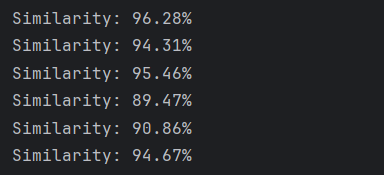
I wanted to find out what was causing the 4-11% difference in text similarity. I started with the biggest difference, which was 89.47%
“While I was walking, all of a sudden I heard a voice from the sky. I looked up and saw the same angel who had visited me at the cave of Hira’ sitting on a chair between the sky and the earth. I got afraid of him and came back home and said, ‘Wrap me (in blankets).’ And then Allah revealed the following Holy Verses (of Quran): ‘O you (i.e. Muhammad)! wrapped up in garments!’ Arise and warn (the people against Allah’s Punishment),… up to ‘and desert the idols.’ (74.1-5) After this the revelation started coming strongly, frequently and regularly.”
Sunnah.com
Narrated Jabir bin ‘Abdullah Al-Ansari while talking about the period of pause in revelation reporting the speech of the Prophet “While I was walking, all of a sudden I heard a voice from the sky. I looked up and saw the same angel who had visited me at the cave of Hira’ sitting on a chair between the sky and the earth. I got afraid of him and came back home and said, ‘Wrap me (in blankets).’ And then Allah revealed the following Holy Verses (of Quran):’O you (i.e. Muhammad)! wrapped up in garments!’ Arise and warn (the people against Allah’s Punishment),… up to ‘and desert the idols.’ (74.1-5) After this the revelation started coming strongly, frequently and regularly.”
sahihalbukhari.com from Salafī Publications
The main issue was a slight variation in the wording of a hadith: “Narrated Jabir bin ‘Abdullah Al-Ansari while talking about the period of pause in revelation reporting the speech of the Prophet” This version came from Salafī Publications, but it wasn’t a big issue. After rechecking this specific hadith, the similarity score improved to 99.55%. I also noticed that Sunnah.com replaces “Apostle” with “Messenger (ﷺ),” which lowers the similarity score slightly. Overall, the texts are very similar, but Sunnah.com has made small changes.
Numbering and source of Ṣaḥīḥ al-Bukhārī from Sunnah.com
Finding information about the numbering system was challenging because many websites had been removed or were broken. After checking archive.org, I discovered that Sunnah.com had transitioned to the Tarquīm Muḥammad Fuʾād ʿAbd al-Bāqī numbering system.
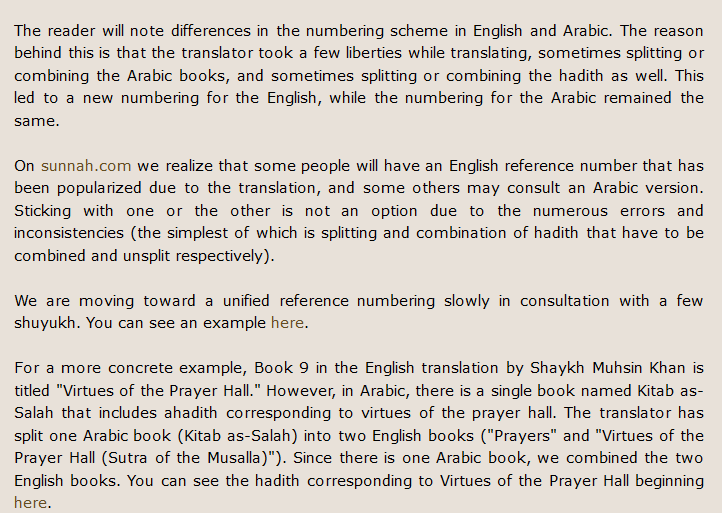
Previously, both Sunnah.com and SahihBukhari.com used a numbering system with 93 chapters stemming from the USC-MSA print while the Muḥsin Khan print extended to 97 chapters. Sunnah.com’s new system now follows the 97-chapter format, though this difference is not significant. The translation used by Sunnah.com originates from the University of Southern California (USC)2, which had it available online as early as the 1990s.
Ṣaḥīḥ Muslim
Ṣaḥīḥ Muslim comes from the same source as Ṣaḥīḥ al-Bukhārī, but there is a significant issue with it there are errors related to creed. Here is an example:
They would say: Yes. and the things would be laid bare.
Sunnah.com
They would say: Yes. and the Shin would be laid bare.
sahihmuslim.com from Salafī Publications & Dar us Salam
يَوْمَ يُكْشَفُ عَن سَاقٍ وَيُدْعَوْنَ إِلَى ٱلسُّجُودِ فَلَا يَسْتَطِيعُونَ
The Day the shin will be uncovered and they are invited to prostration but the disbelievers will not be able [Sahih International]
(Remember) the Day when the Shin shall be laid bare (i.e. the Day of Resurrection) and they shall be called to prostrate (to Allah), but they (hypocrites) shall not be able to do so [Hilali]
Surat Al-Qalam verse 42
The translation of Ṣaḥīḥ Muslim from USC appears to be based on a print that originates from an ʿashari2/sufi3 viewpoint. Notably, it references Ibn Arabi4 who is well known regarding his kufr (disbelief) (wahdat al wujood 5). The printing house responsible for this edition is Sh. Muhammad Ashraf.6, Given this context, it is important to be cautious about the sources we rely on. Salafī Publications has reviewed the aḥādīth, ensuring greater accuracy in their verification process. For this reason, I would not recommend using the version available on Sunnah.com
Sunan Abī Dāwūd
With Sunan Abī Dāwūd, I compared the USC and Darussalam versions to determine which one aligns more closely with the Sunnah.com version. Here is the version from Sunnah.com and USC:
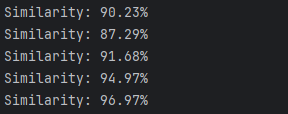
We can see that they are extremely close to each other. Here are the results comparing Darussalam and Sunnah.com:
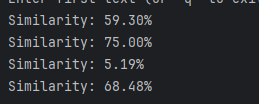
So, we can see that it is not from Darussalam, as the sentences differ too much to match their version. This means the source is USC. On USC, the translation was done by Ahmad Hasan, and the print is the same as that of Ṣaḥīḥ Muslim. However, since the USC translation is incomplete, they finished it using a different translation (This could be Dar us Salam).
Jāmi‘ at-Tirmidhī
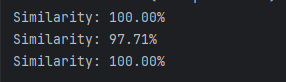
I checked it with Darussalam, and we can see that it is from them. However, I would still recommend taking it directly from the source rather than Sunnah.com, especially considering issues with Ṣaḥīḥ Muslim and Sunan Abī Dāwūd.
Sunan an-Nasā’ī
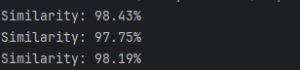
The same applies to Jāmi‘ at-Tirmidhī it is better to take it directly from Darussalam rather than relying on Sunnah.com.
Ustaadh Sa’eed Rhana regarding Sunnah.com
Conclusion
while Sunnah.com provides convenient access to ḥadīth, its reliability varies across different collections.
- For Ṣaḥīḥ al-Bukhārī, the text is largely similar to trusted sources, with minor variations.
- However, Ṣaḥīḥ Muslim on Sunnah.com appears to rely on a translation with theological issues, making it unreliable.
- Sunan Abī Dāwūd’s source is mixed with USC and an other translation.
- Jāmi‘ at-Tirmidhī and Sunan an-Nasā’ī appear to be sourced from Darussalam, but direct consultation is still advised.
And we must take the advice of the Ustadh, who discouraged taking from the website.
Last update on: Mon, 14 ذو القعدة 1446
if you found any mistakes please post a comment and i will change it
- https://www.salafipublications.com/sp/ ↩︎
- Learn more about them ↩︎
- Book from Sh. Muhammad Ashraf, regarding sufism where they also used Ibn Arabi ↩︎
- Shaykh Salih Al-Fawzan regarding Ibn Arabi [ARABIC] ↩︎
- Saying everything you see is Allāh so the sun is Allāh the stone is Allāh, from here the translation of “There is no god but Allāh” came from. And it implies that everything that is worshipped is but Allaah, which necessitates wahdat ul-wujood ↩︎
- Printing house from Pākistan ↩︎
Leave a Reply